
Defining digital infrastructure
Infrastructure is all around us. It forms the backbone of modern economies and daily life, spanning transportation networks, power generation and transmission systems, water and wastewater utilities, and social infrastructure such as hospitals, schools and public facilities. Interest in infrastructure has intensified in recent years as governments, corporations and investors confront a growing need to modernize aging assets while building new capacity for a world that is becoming more digital, energy intensive and informationally connected. Long-term trends including population growth, urbanization, deglobalization, artificial intelligence, electrification and national security priorities are creating sustained demand for investment across infrastructure sectors. Recent estimates suggest global infrastructure spending needs could exceed $100 trillion by 2040.1
Digital infrastructure is one of the fastest-growing and most capital-intensive infrastructure segments. An estimated $19 trillion will be needed by 2040 to build, maintain and operate the infrastructure that underpins the digital economy.1 Digital infrastructure forms the physical backbone of the digital economy, enabling the creation, storage, movement and security of data. These assets include data centers, fiber and broadband networks, wireless towers and connectivity platforms that support both consumer and business applications. Demand for these assets has grown exponentially in recent years, driven by cloud computing, artificial intelligence, 5G deployment and the proliferation of connected devices.
Infrastructure by asset type
Exponential growth in data usage is driving massive investment needs
across compute, storage and power
Examples of current and projected data usage
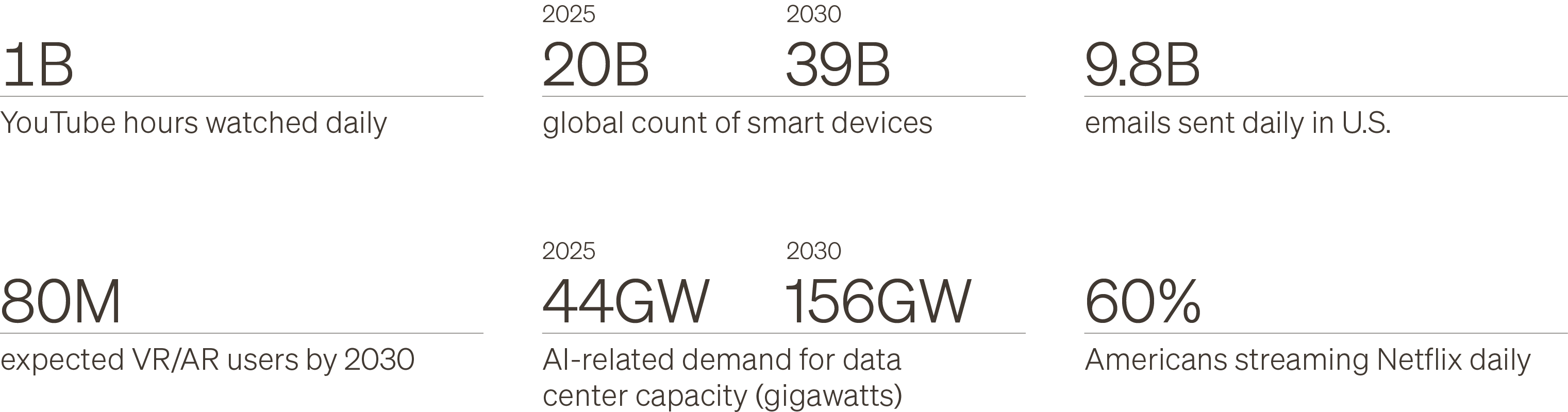
The growth of AI workloads, cloud computing and other data-intensive applications is reshaping the opportunity set for digital infrastructure. At the same time, rising energy demand and data sovereignty considerations are elevating the importance of power infrastructure and geographic location. These trends are blurring the traditional boundaries between infrastructure, energy, real estate and technology, mandating cross‑disciplinary expertise for operators and investors within the space.
Aggregate AI capex estimates

While investment projections vary, the direction of travel is clear. Supporting this expansion will require significant new capacity across data centers, power infrastructure, fiber networks and related assets, creating a broad and durable investment opportunity across the digital infrastructure ecosystem.
Connecting the digital economy
AI is the latest powerful catalyst driving demand for data centers, fiber networks and wireless infrastructure. But growth extends well beyond AI and underpins a massive opportunity to finance the assets that connect users to data. And while data centers may be the most visible component of the buildout—serving as the “factories” of the digital economy—they depend on a broad ecosystem of fiber networks, cloud connectivity and wireless infrastructure to move, store and deliver information. Every transaction, application, cloud workload and connected device relies on this connected system working together, and the massive growth in data center capacity acts as a demand catalyst for this connective tissue.
Comparison of the physical and digital infrastructure ecosystems
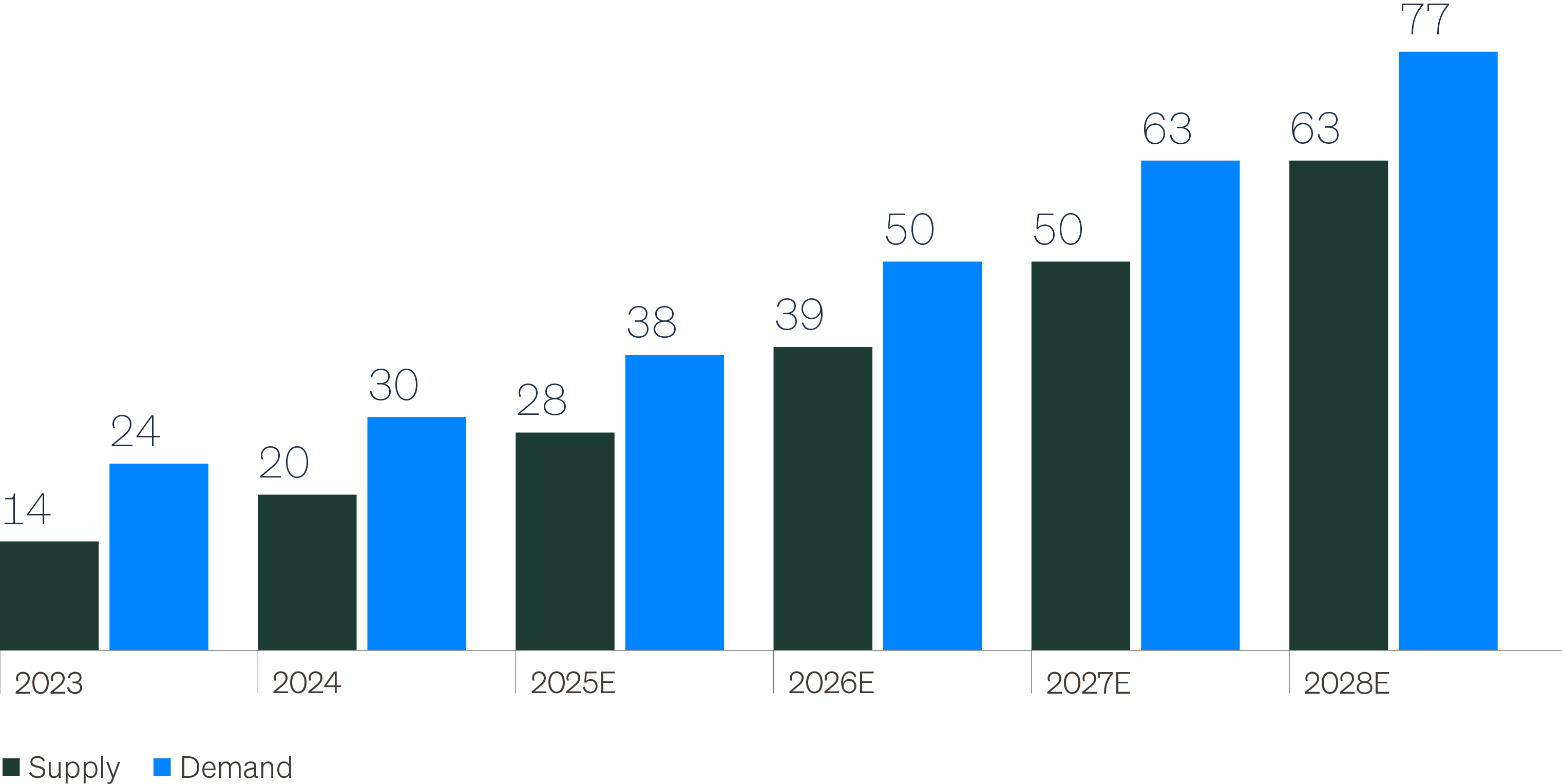
As “information factories,” data centers convert power, land and hardware into capacity that supports cloud services, enterprise software and AI applications. Demand continues to outpace supply, with roughly 80% of data centers under construction in 2025 already pre-leased compared to 52% in 2020.2 While AI is expected to drive much of the incremental demand over the coming decade, non-AI uses—including cloud computing, digital services, software applications and data storage—will require an estimated 255 gigawatts of additional capacity through 2030.3
But expanding factory capacity is only part of the challenge. As more compute comes online via an explosion in data centers, growing volumes of data must be transported between data centers, cloud platforms and enterprises, and distributed to end users. This increases the importance of the infrastructure that connects that ecosystem together.
Data center supply and demand capacity
Gigawatts
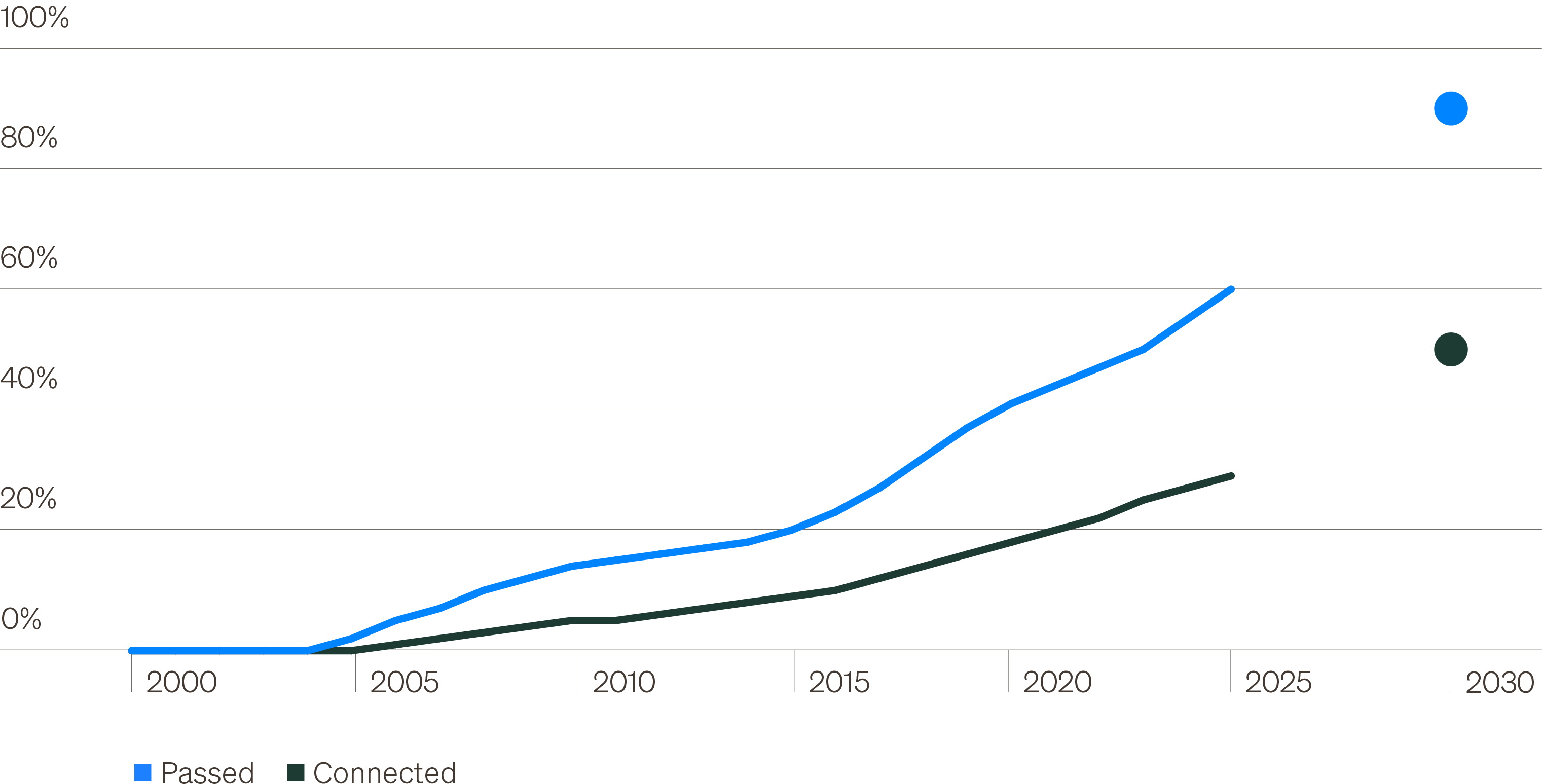
Fiber networks are the information highways, moving data between data centers, homes, businesses, wireless towers and cloud platforms. Fiber-to-the-home (FTTH) networks support residential broadband, while long-haul and data center interconnect routes move large volumes of information across regions with minimal time delay (low latency) and high reliability. Fiber is increasingly important as data centers expand into new markets where power and land may be available, but network capacity is less developed. As data traffic grows, terrestrial fiber routes, subsea cable systems and geographically diverse network pathways will expand capacity and improve network resilience.
U.S. long-haul/data center interconnect changes

Fiber is increasingly important as data centers expand into new markets where power and land may be available, but network capacity is less developed. As data traffic grows, terrestrial fiber routes, subsea cable systems and geographically diverse network pathways will expand capacity and improve network resilience.
% of U.S. homes passed and connected by fiber
Wireless infrastructure such as towers and antennae complete the connectivity loop by acting as a last-mile distribution network, extending data access to mobile users, enterprises and connected devices. Towers, antennae, distributed antenna systems and small cells deliver the final wireless connection between high-capacity fiber networks and end users. Global mobile network traffic, including fixed wireless access, is expected to grow approximately 2.5x by 2031.4 As demand for always-on connectivity grows, these assets require ongoing upgrades, densification and equipment investment to support greater data usage and higher-performance networks.
Global mobile network data traffic

Edge infrastructure brings computing closer to the point of use. While fiber and wireless networks move and deliver data, edge infrastructure relocates processing and storage nearer to where data is generated and consumed. These local computing facilities handle workloads that benefit from proximity, reducing latency and easing traffic on core networks.
The flexibility premium in digital infrastructure
Data centers, fiber networks and towers are among the largest and most established sectors within the digital infrastructure ecosystem. They also account for a significant share of industry capital spending, providing a useful lens through which we can examine the evolving financing needs of the broader market.
These sectors share infrastructure-like characteristics: They are capital intensive, long-lived, difficult to replicate and supported by recurring or contracted demand. Yet, the way capital is structured around each asset type varies meaningfully due to the timing of cash flows and underlying risks. The appropriate financing solution may range from senior secured debt to project finance, securitization, preferred equity or common equity, depending on where an asset sits in its life cycle and its cash flow profile. Private markets are playing an increasingly important role, with private infrastructure assets under management growing from $560 billion in 2016 to $1.5 trillion at year-end 2024.1
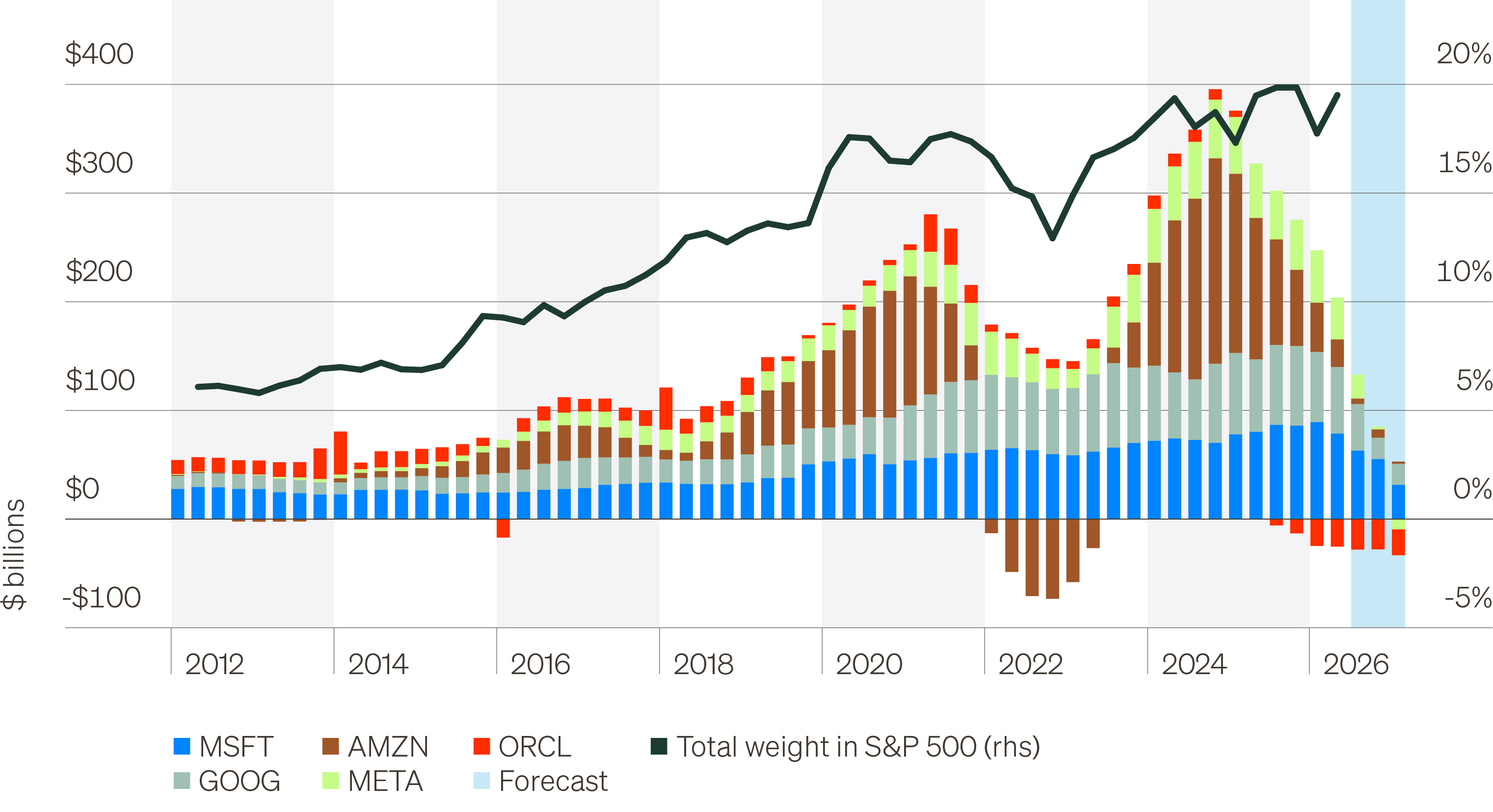
Data centers Hyperscalers have largely footed the AI data center buildout to date by deploying their vast sums of free cash flow. However, by the end of 2026, the combined run-rate free cash flow for the major hyperscalers (Amazon, Microsoft, Alphabet, Meta and Oracle) is expected to be near zero, driven by massive and growing AI-related spending.
Hyperscaler free cash flow
Trailing 12 months (actual and forecast)
Morgan Stanley estimates the data center build-out will face a $1.5 trillion funding gap through year-end 2028. Much of that gap is expected to be met by private credit and private asset-based finance markets due to the need for large, customized financing solutions often tied to long-term lease cash flows, which do not always align well with the standardized terms for banks or ABS/CMBS securitizations. Furthermore, since data centers are increasingly financed like a hybrid of infrastructure, real estate and corporate technology capex, they require specialized capital solutions that can match distinct risk profiles across development, construction and stabilized operations, drawing on different investor bases as assets transition from build-out to cash flow.
Estimated financing need for data centers through 2028 (ex-power)

Fiber and network assets Fiber deployment is highly capital-intensive, and development projects often take three to four years before operating cash flows are sufficient to support debt service and generate sustainable returns. U.S. broadband and fiber networks have historically been built and funded by large telecom, cable and wireless operator companies, with government programs mainly supporting less profitable rural areas. The 1996 Telecom Act opened the door to deregulation and increased competition from new builders, specialized operators and eventually external investors seeking the return profiles of steady, long-term contracts.
The type of capital used to finance a fiber project depends largely on where the asset sits in its development and operating life cycle. Below, we highlight the various capital providers for FTTH and long-haul/Data Center Interconnect, the two largest segments of fiber installations today.
Towers Telecom towers were historically built and funded directly by wireless carriers. Over time, these assets were carved out into specialized tower companies and REITs that could access public equity and debt markets. Today, large tower operators fund growth and maintenance capex through a mix of retained cash flow, unsecured bonds, bank credit facilities and increasingly private infrastructure capital and asset‑backed financing. The model is supported by long-term leases with wireless carriers, built-in rent increases and highly predictable cash flows, although tenant concentration is a notable risk.
Maintaining and upgrading these networks still requires significant ongoing investment—carriers and tower companies collectively spend tens of billions of dollars annually to support 5G upgrades, equipment deployments and network densification. Looking ahead, larger, well-capitalized platforms are likely to retain the broadest access to capital, while private investors and structured finance will play a growing role in funding upgrades, refinancing existing debt and consolidating smaller portfolios.
Capital needs extend well beyond data centers, fiber and network assets, and towers, encompassing edge infrastructure, cloud enablement businesses, network equipment providers and the broader ecosystem that supports digital connectivity. Across these segments, a common theme emerges: The growing need for flexible and specialized financing solutions tailored.
Summary
Digital infrastructure has become one of the fastest-growing and most capital-intensive segments of the global economy, encompassing far more than data centers alone. As compute capacity expands, so too does the need for the infrastructure that connects it—and the capital required to finance these critical projects. As we look ahead, the financing for this buildout will need to be flexible and specialized, tailored to different operating models, cash flow profiles and stages of development. The greatest opportunities will likely accrue to investors who pair cross-disciplinary expertise with the flexibility to provide capital across the full spectrum of debt, equity and hybrid solutions.